
What is ISO on a camera? It is the setting that tells the camera how bright the finished photo should look for the light it has captured. Raise ISO and the image brightens, but noise becomes more visible. The useful skill is choosing an ISO that protects the shutter speed and aperture your picture needs.
How ISO makes a photo brighter without adding light
ISO comes from the International Organization for Standardization. In photography, it refers to a standardized sensitivity rating with roots in film speed, where faster film required less exposure time. On digital cameras, ISO is not the sensor’s physical sensitivity. Instead, raising ISO amplifies the electrical signal from the sensor after light has been captured, making the output brighter.
Common full-stop values run in a sequence: ISO 100, 200, 400, 800, 1600, 3200, and 6400. Each doubling represents a one-stop increase in brightness at the same aperture and shutter speed. For example, moving from ISO 100 to ISO 200 doubles the brightness of the image, but the camera has not collected more light.
Aperture and shutter speed physically capture light; ISO merely brightens the result while also amplifying noise.
Use ISO with aperture and shutter speed, not against them
The exposure triangle links aperture, shutter speed, and ISO. Changing one requires adjusting at least one other for a properly exposed photo. Each control protects something different: shutter speed controls motion blur, aperture controls depth of field, and ISO controls brightness plus noise.
Start with the setting you cannot compromise. To freeze action, set a fast shutter speed. For front-to-back sharpness, set a smaller aperture. In good light, keep ISO at base ISO; when the chosen shutter speed or aperture leaves the photo too dark, increase the ISO.
| What you need | Set first | What ISO solves |
|---|---|---|
| Frozen action | A fast shutter speed | Restores brightness when the fast exposure admits less light |
| More depth of field | A smaller aperture | Offsets the darker image from the smaller opening |
| Clean detail in strong light | Base ISO | Preserves the widest dynamic range and least noise |
A practical beginner workflow is aperture priority: set base ISO, check the shutter speed selected by the camera, and raise ISO if that speed is too slow to handhold. A standard guideline is to avoid shutter speeds below the reciprocal of the lens focal length—for example, 1/50 second with a 50 mm lens.
Choose a starting ISO for the light in front of you
There is no single best ISO. ISO 100 is best for sunny outdoor scenes or flash because it delivers the cleanest image and maximum dynamic range. ISO 400 is common for cloudy days, overcast conditions, or well-lit indoor scenes. When light drops, preserving a sharp shutter speed takes priority.
| Scene | Useful starting point | Why |
|---|---|---|
| Bright sun | ISO 100 | Clean files and broad dynamic range |
| Cloudy daylight or well-lit indoors | ISO 400 | Common balance for reduced light |
| Indoors without flash or dusk | ISO 800 | Helps maintain a practical shutter speed |
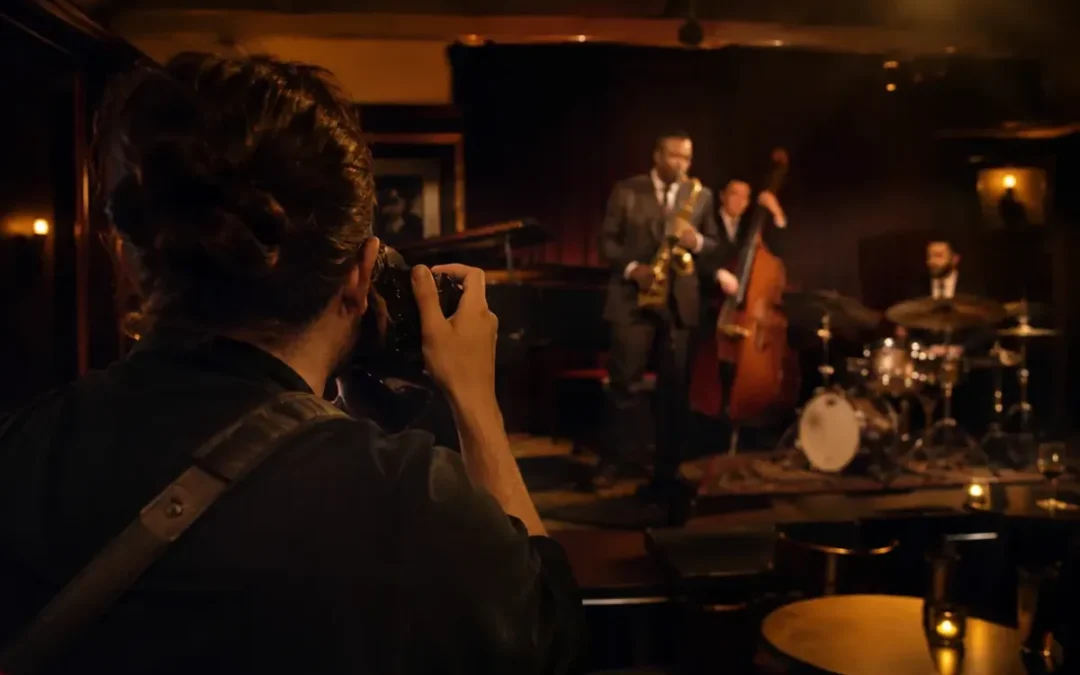
| Indoor sports, concerts, or night events | ISO 1600–3200 | Limited light often demands faster shutter speeds |
For bright sun, the Sunny 16 rule provides a baseline: at f/16, set shutter speed to the reciprocal of the ISO, such as ISO 100 at 1/125 second or ISO 400 at 1/500 second. In hazy sun or slight overcast, f/11 provides one stop less light than full sun; overcast conditions call for f/8, and heavy overcast or open shade for f/5.6.
In deep shade, use f/4 or wider. For indoor sports, typical settings are the widest available aperture (such as f/2.8), at least 1/500 second, and ISO 1600–3200 or higher. If ISO 1600 at f/5.6 cannot achieve 1/500 second, a lens with a faster maximum aperture is needed.
Why high ISO creates noise—and when it is worth it
Digital noise is random variation in brightness or color information. Luminance noise reflects brightness variation and resembles film grain; chrominance noise appears as color speckles and is more objectionable. A higher ISO amplifies the image signal along with noise. Darker regions show more visible noise because they have a lower signal-to-noise ratio where less light was captured.
ISO 1600 is appropriate when it delivers the shutter speed required for a sharp photo in limited light; a noisy sharp photo is better than a clean blurry one. ISO 6400 and above are extreme settings often required for handheld night photography or poorly lit arenas.
Slightly overexposing while protecting highlights can reduce visible noise because a stronger signal drowns out the noise floor. Shooting RAW provides the most latitude for noise reduction in post-processing. Excessive luminance noise removal should be avoided so images do not look unnaturally plastic.
Base ISO gives you the cleanest starting file
Base ISO is the lowest native ISO on a camera, where the sensor applies its lowest gain. It delivers the highest image quality, widest dynamic range, least noise, and most editing latitude. On most cameras base ISO is 100, though some models have base ISO 200 or ISO 64.
Expanded ISO settings below base ISO, such as ISO 50 on a camera with base ISO 100, are not true native sensitivities; they use software processing and reduce dynamic range compared to the base setting. Some modern cameras feature dual base ISO, offering a second, higher gain state optimized to read weak low-light signals cleanly.
Shoot at base ISO in good light. Raise it when a faster shutter speed to freeze motion or a smaller aperture for depth of field is necessary.
Let Auto ISO protect your shutter speed as light changes
Auto ISO adjusts ISO within user-defined limits (a maximum ISO ceiling and a minimum shutter speed) to maintain correct exposure as lighting changes. The camera uses the lowest possible ISO first and raises it only when shutter speed would drop below the threshold.
For scenes mixing bright sun and deep shade, such as a wedding procession moving outdoors to indoors, Auto ISO with a minimum shutter speed of 1/125 second and a maximum of ISO 3200–6400 maintains exposure automatically. On many cameras, the minimum shutter speed can be set to Auto, choosing roughly the reciprocal of the lens focal length (e.g., 1/50 second for a 50 mm lens).
Auto ISO can also operate in Manual mode on supported cameras, letting you lock both aperture and shutter speed while the camera adjusts ISO to maintain exposure.
Three ISO myths that get in the way of better photos
“Higher ISO makes the sensor more sensitive to light.”
Not physically. Aperture and shutter speed determine the light captured; raising ISO amplifies the electrical signal after capture to brighten the image.
“Always use the lowest ISO.”
Base ISO is ideal in good light, but it should not cause motion blur. Raise ISO whenever necessary to maintain the shutter speed or aperture your subject requires.
“ISO 1600 is too high.”
ISO 1600 to 3200 is typical for indoor sports, concerts, and night events where fast shutter speeds are needed in limited light.
Frequently Asked Questions
What does ISO mean on a camera?
ISO is a standardized rating that tells a digital camera how bright the output photo should be for a given amount of captured light. Higher values amplify the signal, brightening the image while also increasing visible noise.
How does ISO affect image brightness and noise?
Each doubling of ISO adds one stop of brightness at the same aperture and shutter speed. This amplification also increases visible noise, particularly in darker areas where less light was captured.
Is ISO 100 or 400 better?
ISO 100 is best for sunny outdoor scenes or flash, providing the cleanest image and maximum dynamic range. ISO 400 is common for cloudy days, overcast conditions, or well-lit indoor scenes.
What ISO is best for sunny days?
ISO 100 is standard for sunny outdoor conditions. Under the Sunny 16 rule at f/16, pair it with a shutter speed equal to the reciprocal of the ISO, such as 1/125 second.
How do you choose ISO for different lighting conditions?
Prioritize shutter speed to freeze motion or aperture for depth of field. Begin at base ISO in good light, and increase ISO when necessary to preserve those settings in lower light.
What is base ISO, and why does it matter?
Base ISO is the lowest native ISO setting where the camera applies its lowest gain. It provides the highest image quality, widest dynamic range, and lowest noise floor.